



How to Reduce Home Office Noise with Curtains Without Losing the Light You Need to Work
Home office noise is a particular kind of torment. It's not the nighttime street sounds that wake you; it's the leaf blower at 10 a.m., the neighbor's dog, the delivery truck idling outside your window right when you're trying to concentrate on a complex task. And unlike bedroom noise, you can't just block it all out with heavy blackout curtains. You need daylight to work, to stay alert, to avoid that grim cave-office feeling that makes everything harder.
This is where most noise-cancelling curtain advice falls short. It treats all noise problems the same, recommending the same thick, light-blocking panels whether you're trying to sleep or trying to work. But home office acoustics require a different strategy entirely, one that balances sound dampening with natural light transmission.
The Decibel Reality: What Noise Reduction Actually Means in a Home Office
First, let's talk about what "noise cancelling" curtains actually do, because the terminology is misleading. These curtains don't cancel noise the way headphones do. They absorb and dampen sound waves, reducing the volume of external noise that enters your space and minimizing echo within the room.
Most quality acoustic curtains reduce noise by 7-10 decibels. Higher-end options claim 15-21 decibel reduction. Here's what that means practically: a 10-decibel reduction makes noise sound approximately half as loud to the human ear. That lawn mower outside goes from "extremely distracting" to "noticeable but manageable." It's not silence, but it's the difference between losing your focus every thirty seconds and being able to maintain concentration through ambient disruption.
The lesser-known fact: decibel reduction isn't linear with fabric weight. A curtain that's twice as heavy doesn't block twice the sound. There's a point of diminishing returns around 3-4 pounds per square yard of fabric, where adding more weight adds minimal acoustic benefit but significantly reduces light transmission. This is the critical threshold for home office curtains, you want to stay in the effective acoustic range without crossing into blackout territory.
The Light-and-Sound Trade-Off: Understanding Fabric Physics
Here's what most guides won't tell you: the same fabric properties that block sound also block light. Dense, tightly-woven fabrics with minimal air gaps absorb sound waves effectively. They also prevent photons from passing through. This isn't a design flaw, it's physics.
The trick is choosing fabrics that optimize for sound absorption at specific frequencies (particularly the 125-2000 Hz range where most environmental noise lives) while maintaining some light permeability. This usually means:
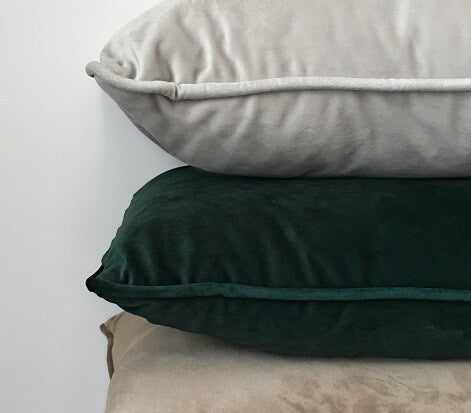
Microsuede or velvet face fabrics: These have textured surfaces that disrupt sound waves without requiring extreme thickness. The nap (raised fibers) creates air pockets that absorb sound energy.
Mid-weight linen blends: Natural linen at 7-9 ounces per square yard offers surprising acoustic dampening, its irregular weave creates sound-scattering surfaces, while still allowing diffused daylight through. Blending with polyester adds mass without significantly increasing opacity.
Layered construction without blackout backing: Multi-layer curtains (face fabric + interlining + lining) provide acoustic mass without the rubberized or foam blackout backing that creates total darkness. The interlining is key, materials like cotton flannel or thin wool felt add acoustic absorption while remaining somewhat light-permeable.
What you're after is opacity in the 40-60% range: enough to soften direct sunlight and create privacy, while still allowing ambient daylight to fill your workspace.
The Layering Strategy Most Home Workers Miss
Here's a genuinely lesser-known approach: using a two-curtain system with different functions.
Install a heavier acoustic curtain (that 3-4 pound per square yard range) on a track closest to the window. This is your sound barrier. Then layer a sheer or semi-sheer curtain on a separate track in front of it, closer to the room. During work hours, keep the acoustic curtain open and the sheer drawn. The sheer provides privacy and glare reduction while letting maximum light in. When noise levels spike, the construction crew arrives, the neighborhood kids are out for lunch, pull the acoustic curtain closed for 20-30 minutes of focused work.
This gives you control over the trade-off moment by moment, rather than forcing a single compromise position.
The acoustic curtain in this system can actually be darker than you'd normally choose, because it's not your default position. You're using it strategically, for noise emergencies, not all day. This means you can opt for more aggressive sound dampening without living in a dim room.
Installation Decisions That Multiply Acoustic Performance
Even the best acoustic curtain will underperform if it's installed wrong. For home office noise reduction specifically:
Extend beyond the window frame: Mount your curtain rod 6-8 inches beyond the window on each side, and 4-6 inches above. Sound leaks around edges. Every gap is a pathway for noise to enter at full volume. The curtain needs to overlap the wall itself, creating a sealed acoustic barrier.
Add weight at the bottom: Most curtains hang freely, creating a gap between the fabric and the windowsill where sound pours in. Use a bottom hem weighted with chain or shot-filled tape. This creates a seal and adds mass where it matters most, low-frequency sounds (traffic rumble, bass from music) travel along the floor and window base.
Use returns: These are the short sections of fabric that extend from the rod back to the wall at each end. They close the gap at the top corners where the curtain meets the wall. Many people skip this detail, not realizing those two small triangles of open space can leak substantial noise.
Consider a pelmet or valance: A fabric-covered box mounted above the curtain further seals the top gap. It looks decorative, but it's functionally acoustic.
These installation strategies can add 2-4 decibels of additional noise reduction, nearly as much as upgrading to a heavier fabric.
When Sheer Isn't Enough: The Voile and Linen Compromise
If you're in a particularly noisy environment like an urban apartment, busy street, near a school or park, and truly can't sacrifice more light, there's an intermediate solution: heavyweight sheers.
These aren't the wispy decorator voiles most people think of. Look for linen-blend sheers in the 5-6 ounce range, or ripple-fold sheers with a denser weave. They read as translucent but provide more acoustic mass than standard sheer fabric.
The reality: these will give you perhaps 3-5 decibels of noise reduction. Not as much as proper acoustic curtains, but better than nothing, and they maintain 70-80% light transmission. For some home workers, especially those whose noise issues are moderate (occasional disturbances rather than constant din), this lighter-touch approach is enough.
Pair heavyweight sheers with soft furnishings elsewhere in the room, an upholstered chair, a wool rug, fabric wall art, to absorb sound reflections within the space. Remember, home office acoustics aren't just about blocking external noise; they're also about preventing echo and reverberation that make video calls sound tinny and make the environment feel harsh.
The Natural Light Factor: Why It Matters More in a Home Office
It's worth understanding why you're making this trade-off at all. Natural light in a workspace affects alertness, mood, and circadian rhythm regulation. Exposure to daylight during working hours, particularly morning and early afternoon, helps maintain your natural sleep-wake cycle, making it easier to fall asleep when you actually want to at night.
Working in a darkened room with only artificial light suppresses daytime cortisol and advances melatonin production, essentially telling your body it's evening when it's not. Over time, this creates a phase delay in your sleep schedule, you'll find yourself unable to fall asleep at a reasonable hour, lying awake until 1 or 2 a.m., then struggling to wake in the morning. Home workers who use blackout curtains during the day often develop this pattern without realizing the cause.
This is why the light-versus-sound balance in a home office actually matters for your sleep, even though you're not sleeping in that room. Your daytime light exposure shapes your nighttime sleep quality.
Realistic Expectations: What Curtains Can and Cannot Do
Acoustic curtains are a meaningful intervention for home office noise, but they're not a miracle. They work best for:
- Mid-to-high frequency sounds: voices, dog barking, leaf blowers, traffic noise
- Moderately loud disturbances: 60-75 decibel range
- Reducing room echo: improving the acoustic quality of your own space
They're less effective for:
- Very low-frequency sounds: bass rumble, subwoofers, heavy construction vibration
- Impact noise: footsteps from upstairs neighbors (that's structural transmission, not airborne)
- Extremely loud continuous noise: if you're next to a highway or construction site, you need more than curtains (secondary glazing, acoustic panels, sealing air gaps around windows)
If your noise issues are severe, curtains should be one component of a multi-layered acoustic strategy, not your only solution. But for the typical home worker dealing with neighborhood noise, delivery trucks, and outdoor activity, the right curtains can reduce distraction enough to make focused work possible again.
Frequently Asked Questions
Q: Can noise-reducing curtains work without blocking all natural light?
A: Yes, but it requires choosing fabrics in the 3-4 pound per square yard range with textured surfaces (velvet, microsuede) or layered construction without blackout backing. These typically offer 7-10 decibel reduction while maintaining 40-60% light transmission, enough to keep your workspace bright while dampening disruptive noise.
Q: How much noise reduction do I actually need in a home office?
A: For most home workers, 7-10 decibels makes the difference between constant distraction and manageable background noise. This level cuts perceived loudness roughly in half. If your noise issues are severe (construction, very busy street), look for curtains claiming 15+ decibel reduction, but expect these to block more light as well.
Q: Is it better to have one heavy curtain or multiple lighter layers?
A: For home offices, a two-track system with separate acoustic and sheer curtains gives you the most flexibility. You can use the sheer layer for daily privacy and light diffusion, then close the acoustic layer during noise disruptions. This prevents you from working in unnecessary darkness while maintaining the option for serious sound dampening when needed.
Q: Do noise-cancelling curtains help with echo and reverberation inside the room?
A: Yes, significantly. The same sound-absorbing properties that reduce external noise also dampen sound reflections within your space. This makes your home office acoustically softer, particularly noticeable on video calls, where your voice will sound warmer and more natural rather than echoey or harsh.
If you're ready to reclaim focus in your home office without sacrificing the natural light that keeps you alert and supports healthy sleep patterns, explore Sandman's Shop's collection of curtains designed for the specific balance working-from-home requires.